Showing posts with label muslim. Show all posts

Thursday, December 13, 2012

New FBI Hate Crime Stats: Again Jews, NOT Muslims, Majority Victims

By Debbie Schlussel
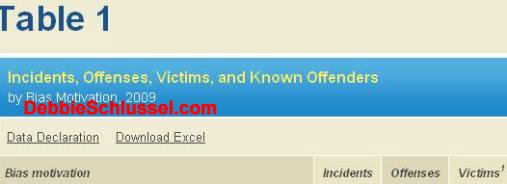
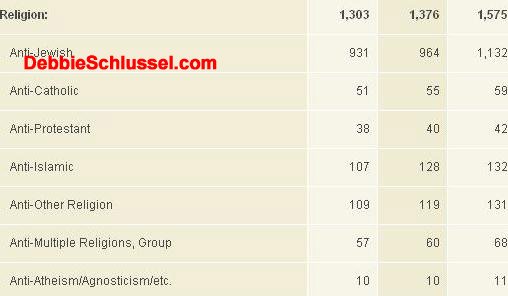
Nearly every year, I write about the FBI’s annual hate crimes statistics.  And every year, the biggest victims by far–in terms of religious discrimination–are Jews, NOT Muslims (see my reports on the 2008 and 2007 stats).  That’s despite the Muslim victimhood and oppression merchants’ annoying whines about “backlash.” If anything, there is forelash–we bend over, they insert. And in the same forelash vein, also this year–like every other year–the FBI declines to identify the perpetrators of the hate crimes by religion.  If that happened, as I’ve noted before, we’d probably see that a good deal of the perpetrators of anti-Jewish hate crimes are Muslims.  Below are the just-released FBI 2009 Hate Crimes Statistics. As you’ll note, the only thing that has changed is that the percentage of hate crimes against Jewish hate crimes has increased from 67% to 72% of all religion-based hate-crimes.

That Was Then . . .
swastika.jpgyellowstar.jpg
This Is Now . . .
islamiccrescent.jpgyellowstar.jpg
Religious bias
Of the 1,575 victims of an anti-religious hate crime:
* 71.9 percent were victims because of an offender’s anti-Jewish bias.
* 8.4 percent were victims because of an anti-Islamic bias.

* 3.7 percent were victims because of an anti-Catholic bias.
* 2.7 percent were victims because of an anti-Protestant bias.
* 0.7 percent were victims because of an anti-Atheist/Agnostic bias.
* 8.3 percent were victims because of a bias against other religions (anti-other religion).
* 4.3 percent were victims because of a bias against groups of individuals of varying religions (anti-multiple religions, group). (Based on Table 1.)

Defining A Hate Crime

A hate crime is the victimization of an individual based on that individual's race, religion, national origin, ethnic identification, gender, or sexual orientation.

Acts include:

  • Rape and Sexual Assault
  • Physical assault(s) with weapons
  • Verbal or physical harassment
  • Vandalism/robbery
  • Attacks on homes or places of worship

How does this relate to rape and sexual assault?

While any targeted group can experience rape and sexual assault as a form of hate crime, there are two groups that are often noted for being victims of this particular form of hate crime.
  • Women: Many believe that all violence against women, including rape and sexual assault, is a hate crime because it is not simply a violent act, but is "an act of misogyny, or hatred of women" (Copeland & Wolfe, 1991).
  • People in the LGBT Community: Members of the Lesbian, Gay, Bisexual, and Transgendered (LGBT) community are often targets of hate crimes, many of which include rape or sexual assault. In one study of almost 2,000 lesbian and gay individuals in Sacramento, CA, about one-fifth of the women and one-fourth of the men had been victimized at some point during the past 5 years (APA, 1998; "Safety and Hate Crimes," 2006).

Effects

Because a hate crime is an attack on an individual due to his or her identity affiliation (race, gender, sexual orientation, religion, ethnicity, national origin, etc.), the emotional effects of a rape or sexual assault as a hate crime can be compounded. An individual may not only experience the reactions that often follow a rape or sexual assault, he or she may also suffer from additional effects brought on by the attack of their identity. These reactions can include:
  • Deep personal hurt, betrayal
  • Feelings of powerlessness, vulnerability, anger, sadness
  • Fear for personal and family's safety
  • Changes in lifestyle (where they walk, how they answer the phone, their reactions to strangers)
In addition, research has shown that victims of hate crimes are more likely to experience psychological distress such as post-traumatic stress disorder, depression, and anger than other victims of other crimes. Therefore, if an individual is a victim of a rape or sexual assault that is a hate crime, he or she is more likely to experience psychological effects that are seen both with hate crimes and rape and sexual assault.
Finally, the recovery time can also be prolonged. Research has shown that it can take as much as five years for victims of hate crimes to overcome the emotional and psychological distress caused by such an attack (APA, 1998).

Hate Crimes Accounting Annual Report Released

In 2011, U.S. law enforcement agencies reported 6,222 hate crime incidents involving 7,254 offenses, according to our just-released Hate Crime Statistics, 2011 report. These incidents included offenses like vandalism, intimidation, assault, rape, murder, etc. The data contained in this report, which is a subset of the information that law enforcement submits to the FBI’s Uniform Crime Reporting program, includes the following categories: offense type, location, bias motivation, victim type, number of individual victims, number of offenders, and race of offenders. Highlights from the 2011 Report: Of the 6,222 reported hate crimes, 6,216 were single-bias incidents—46.9 percent were racially motivated, 20.8 percent resulted from sexual orientation bias, 19.8 percent were motivated by religious bias, 11.6 stemmed from ethnicity/national origin bias, and 0.9 percent were prompted by disability bias. Breakdown of Bias cases Law enforcement agencies reported 7,713 victims of hate crime—victims can be individuals, businesses, institutions, or society as whole. Sixty percent of these 7,713 were victims of crimes against persons, while 39.8 were victims of crimes against property. Thirty-two percent of the 6,222 hate crime incidents reported took place in or near residences; 18 percent took place on highways, roads, and alleys; and 9.3 percent took place at schools or colleges. The remaining percentage took place at locations like houses of worship, parking lots, bars, government and office buildings, etc. New in Hate Crime Reporting Beginning in 2013, law enforcement agencies reporting hates crimes will be able to get even more specific when reporting bias motivation. For example, the new bias categories of gender and gender identity—which added four new bias types—were added to the FBI’s hate crime data collection as a result of the Matthew Shepard and James Byrd, Jr., Hate Crimes Prevention Act. Other bias types were modified to comply with the race and ethnicity designations specified by the U.S. Office of Management and Budget. Data submitted under these new specifications will be part of the UCR program’s new system, scheduled to go online next year. (The 2013 crime data will be published in 2014). 2012 Successes in Investigating Hate Crimes - In December, two Mississippi men pled guilty to federal hate crimes for their roles in assaulting African-Americans in Jackson. More - In November, a South Carolina man was sentenced for committing a federal hate crime against an African-American teenager. More - In October, a Louisiana man pled guilty to charges of defacing places of worship and lying to an FBI agent. More - In September, a jury in Cleveland convicted 16 defendants on federal hate crime charges for religiously motivated assaults on members of the Amish community. More - In August, a Detroit man pled guilty to a federal hate crime charge, admitting he assaulted a victim because he thought the man was gay. More - In April, three Houston men were sentenced to federal prison on federal hate crime charges related to a racially motivated attack against a man waiting at a bus stop. More FBI’s Role in Investigating Hate Crimes Hate crimes continue to be the highest priority of the Bureau’s civil rights program because of their heinous nature and their impact on victims and communities (see sidebar for case examples). We investigate hate crimes that fall under federal jurisdiction, assist state and local authorities during their own investigations, and in some cases—with the U.S. Department of Justice Civil Rights Division—monitor developing situations to determine if federal action is appropriate. In addition to responding to hate crimes, we’re also taking a proactive approach to hate crimes overall. We’re integrating a cadre of analysts with our experienced investigators to not only establish a national threat picture but to identify risk factors that can be used by FBI field offices to assess the potential for hate crimes at the local level. Increasing Hate Crime Awareness Most of all, we’re working to increase awareness of these crimes by establishing liaisons with civic and religious leaders and credible community organizations. Through our UCR program, we offer training to help law enforcement recognize hate crimes and also assist our partners in developing their own hate crimes training programs.


Breakdown of Bias cases