Showing posts with label jewish. Show all posts

Thursday, December 13, 2012

The Biggest Hate Crime in History.

  • The Holocaust began in 1933 when Adolf Hitler came to power in Germany and ended in 1945 when the Nazis were defeated by the Allied powers.
  • The term "Holocaust," originally from the Greek word "holokauston" which means "sacrifice by fire," refers to the Nazi's persecution and planned slaughter of the Jewish people. The Hebrew word "Shoah," which means "devastation, ruin, or waste," is also used for this genocide.
  • In addition to Jews, the Nazis targeted Gypsies, homosexuals, Jehovah's Witnesses, and the disabled for persecution. Anyone who resisted the Nazis was sent to forced labor or murdered.
  • The term "Nazi" is an acronym for "Nationalsozialistishe Deutsche Arbeiterpartei" ("National Socialist German Worker's Party").
  • The Nazis used the term "the Final Solution" to refer to their plan to murder the Jewish people.
The Big Numbers
  • It is estimated that 11 million people were killed during the Holocaust. Six million of these were Jews.
  • The Nazis killed approximately two-thirds of all Jews living in Europe.
  • An estimated 1.1 million children were murdered in the Holocaust.
Persecution Begins
  • On April 1, 1933, the Nazis instigated their first action against German Jews by announcing a boycott of all Jewish-run businesses.
  • The Nuremberg Laws, issued on September 15, 1935, began to exclude Jews from public life. The Nuremberg Laws included a law that stripped German Jews of their citizenship and a law that prohibited marriages and extramarital sex between Jews and Germans. The Nuremberg Laws set the legal precedent for further anti-Jewish legislation.
  • Nazis then issued additional anti-Jews laws over the next several years. For example, some of these laws excluded Jews from places like parks, fired them from civil service jobs (i.e. government jobs), made Jews register their property, and prevented Jewish doctors from working on anyone other than Jewish patients.
  • During the night of November 9-10, 1938, Nazis incited a pogrom against Jews in Austria and Germany in what has been termed, "Kristallnacht" ("Night of Broken Glass"). This night of violence included the pillaging and burning of synagogues, breaking the windows of Jewish-owned businesses, the looting of these stores, and many Jews were physically attacked. Also, approximately 30,000 Jews were arrested and sent to concentration camps.
  • After World War II started in 1939, the Nazis began ordering Jews to wear a yellow Star of David on their clothing so that Jews could be easily recognized and targeted.
Ghettos
  • After the beginning of World War II, Nazis began ordering all Jews to live within certain, very specific, areas of big cities, called ghettos.
  • Jews were forced out of their homes and moved into smaller apartments, often shared with other families.
  • Some ghettos started out as "open," which meant that Jews could leave the area during the daytime but often had to be back within the ghetto by a curfew. Later, all ghettos became "closed," which meant that Jews were trapped within the confines of the ghetto and not allowed to leave.
  • A few of the major ghettos were located in the cities of Bialystok, Kovno, Lodz, Minsk, Riga, Vilna, and Warsaw.
  • The largest ghetto was in Warsaw, with its highest population reaching 445,000 in March 1941.
  • In most ghettos, Nazis ordered the Jews to establish a Judenrat (a Jewish council) to both administer Nazi demands and to regulate the internal life of the ghetto.
  • Nazis would then order deportations from the ghettos. In some of the large ghettos, 1,000 people per day were loaded up in trains and sent to either a concentration camp or a death camp.
  • To get them to cooperate, the Nazis told the Jews they were being transported to another place for labor.
  • When the Nazis decided to kill the remaining Jews in a ghetto, they would "liquidate" a ghetto by boarding the last Jews in the ghetto on trains.
  • When the Nazis attempted to liquidate the Warsaw Ghetto on April 13, 1943, the remaining Jews fought back in what has become known as the Warsaw Ghetto Uprising. The Jewish resistance fighters held out against the entire Nazi regime for 28 days -- longer than many European countries had been able to withstand Nazi conquest.
Concentration and Extermination Camps
  • Although many people refer to all Nazi camps as "concentration camps," there were actually a number of different kinds of camps, including concentration camps, extermination camps, labor camps, prisoner-of-war camps, and transit camps. (Map)
  • One of the first concentration camps was Dachau, which opened on March 20, 1933.
  • From 1933 until 1938, most of the prisoners in the concentration camps were political prisoners (i.e. people who spoke or acted in some way against Hitler or the Nazis) and people the Nazis labeled as "asocial."
  • After Kristallnacht in 1938, the persecution of Jews became more organized. This led to the exponential increase in the number of Jews sent to concentration camps.
  • Life within Nazi concentration camps was horrible. Prisoners were forced to do hard physical labor and yet given tiny rations. Prisoners slept three or more people per crowded wooden bunk (no mattress or pillow). Torture within the concentration camps was common and deaths were frequent.
  • At a number of Nazi concentration camps, Nazi doctors conducted medical experiments on prisoners against their will.
  • While concentration camps were meant to work and starve prisoners to death, extermination camps (also known as death camps) were built for the sole purpose of killing large groups of people quickly and efficiently.
  • The Nazis built six extermination camps: Chelmno, Belzec, Sobibor, Treblinka, Auschwitz, and Majdanek. (Auschwitz and Majdanek were both concentration and extermination camps.)
  • Prisoners transported to these extermination camps were told to undress to take a shower. Rather than a shower, the prisoners were herded into gas chambers and killed. (At Chelmno, the prisoners were herded into gas vans instead of gas chambers.)
  • Auschwitz was the largest concentration and extermination camp built. It is estimated that 1.1 million people were killed at Auschwitz. 

New FBI Hate Crime Stats: Again Jews, NOT Muslims, Majority Victims

By Debbie Schlussel
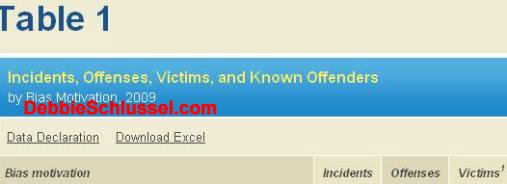
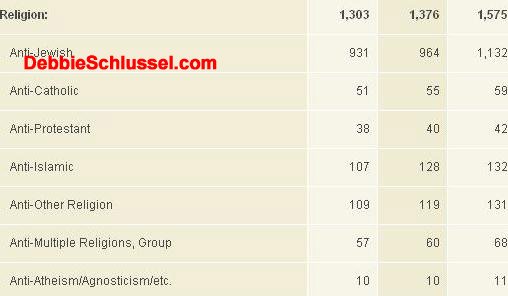
Nearly every year, I write about the FBI’s annual hate crimes statistics.  And every year, the biggest victims by far–in terms of religious discrimination–are Jews, NOT Muslims (see my reports on the 2008 and 2007 stats).  That’s despite the Muslim victimhood and oppression merchants’ annoying whines about “backlash.” If anything, there is forelash–we bend over, they insert. And in the same forelash vein, also this year–like every other year–the FBI declines to identify the perpetrators of the hate crimes by religion.  If that happened, as I’ve noted before, we’d probably see that a good deal of the perpetrators of anti-Jewish hate crimes are Muslims.  Below are the just-released FBI 2009 Hate Crimes Statistics. As you’ll note, the only thing that has changed is that the percentage of hate crimes against Jewish hate crimes has increased from 67% to 72% of all religion-based hate-crimes.

That Was Then . . .
swastika.jpgyellowstar.jpg
This Is Now . . .
islamiccrescent.jpgyellowstar.jpg
Religious bias
Of the 1,575 victims of an anti-religious hate crime:
* 71.9 percent were victims because of an offender’s anti-Jewish bias.
* 8.4 percent were victims because of an anti-Islamic bias.

* 3.7 percent were victims because of an anti-Catholic bias.
* 2.7 percent were victims because of an anti-Protestant bias.
* 0.7 percent were victims because of an anti-Atheist/Agnostic bias.
* 8.3 percent were victims because of a bias against other religions (anti-other religion).
* 4.3 percent were victims because of a bias against groups of individuals of varying religions (anti-multiple religions, group). (Based on Table 1.)

Hate Crimes Statistics: 1995-2007

Hate Crimes Statistics: 1995-2007


Hate Crimes statistics collected by the FBI under the Uniform Crime Reporting program. Please Note that these figures represent Incidents, and not Offenses or Victims or Known Offenders. This means that other charts on the web may show other figures. These figures are based on the FBI reports, which are updated before being posted on the FBI web page. Please review these facts before sending us e-mail that our figures are wrong. Thanks. To see the original reports, visit: http://www.fbi.gov/ucr/ucr.htm#hate
"Bias Crime—A criminal offense committed against a person or property which is motivated, in whole or in part, by the offender’s bias against a race, religion, disability, sexual orientation, or ethnicity/national origin; also known as Hate Crime." -- Hate Crime Data Collection - http://www.fbi.gov/ucr/hatecrime.pdf

Bias Motivation

1995 
1996 
1997 
1998 
1999 
2000 
2001
2002
2003
2004
2005
2006
2007
Totals 7,947 8,759 8,049 7,755 7,876 8,063 9,730 7,462 7,489 7,649 7,163 7,722 7,6245

Race

4,831 5,396 4,710 4,321 4,295 4,337 4,367 3,642 3,844 4,042 3,919 4,000 3,870
   Anti-White 1,226 1,106 993 792 781 875 891 719 830 829 828 890 749
   Anti-Black 2,988 3,674 3,120 2,901 2,958 2,884 2,899 2,486 2,548 2,731 2,630 2,640 2,658
   Anti-American Indian/
   Alaskan Native
41 51 36 52 47 57 80 62 76 83 79 60 61
   Anti-Asian/Pacific Islander 355 355 347 293 298 281 280 217 231 217 199 181 188
   Anti-Multi-Racial Group 221 210 214 283 211 240 217 158 159 182 183 229 214

Ethnicity/National Origin

814 940 836 754 829 911 2,098 1,102 1,026 972 944 984 1,007
   Anti-Hispanic 516 564 491 482 466 557 597 480 426 475 522 576 595
   Anti-Other Ethnicity/
   National Origin
298 376 345 272 363 354 1,501 622 600 497 422 408 412

Religion

1,277 1,401 1,385 1,390 1,411 1,472 1,828 1,426 1,343 1,374 1,227 1,462 1,400
   Anti-Jewish 1,058 1,109 1,087 1,081 1,109 1,109 1,043 931 927 954 848 967 969
   Anti-Catholic 31 35 31 61 36 56 38 53 76 57 58 76 61
   Anti-Protestant 36 75 53 59 48 59 35 55 49 38 57 59 57
   Anti-Islamic 29 27 28 21 32 28 481 155 149 156 128 156 115
   Anti-Other Religious Group 102 129 159 125 151 172 181 198 109 128 93 124 130
   Anti-Multi-Religious Group 20 24 24 41 31 44 45 31 24 35 39 73 62
   Anti-Atheism/Agnosticism/etc. 1 2 3 2 4 4 5 3 9 6 4 7 6

Sexual Orientation

1,019 1,016 1,102 1,260 1,317 1,299 1,393 1,244 1,239 1,197 1,017 1,195 1,265
   Anti-Male Homosexual 735 757 760 850 915 896 980 825 783 738 621 747 772
   Anti-Female Homosexual 146 150 188 223 187 179 205 172 187 164 155 163 145
   Anti-Homosexual 103 84 133 158 178 182 173 222 247 245 195 238 304
   Anti-Heterosexual 17 15 12 12 14 22 18 10 14 33 21 26 22
   Anti-Bisexual 18 10 9 17 23 20 17 15 8 17 25 21 22

Disability

-- -- 12 25 19 36 35 45 33 57 53 79 79
   Anti-Physical -- -- 9 13 10 20 12 20 24 23 21 17 20
   Anti-Mental -- -- 3 12 9 16 23 25 9 34 32 62 59

Multiple Bias

6 6 4 5 5 8 9 3 4 7 3 2 3
Totals 7,947 8,759 8,049 7,755 7,876 8,063 9,730 7,462 7,489 7,649 7,163 7,722 7,6245

1995 
1996 
1997 
1998 
1999 
2000 
2001
2002
20032004200520062007

Defining A Hate Crime

A hate crime is the victimization of an individual based on that individual's race, religion, national origin, ethnic identification, gender, or sexual orientation.

Acts include:

  • Rape and Sexual Assault
  • Physical assault(s) with weapons
  • Verbal or physical harassment
  • Vandalism/robbery
  • Attacks on homes or places of worship

How does this relate to rape and sexual assault?

While any targeted group can experience rape and sexual assault as a form of hate crime, there are two groups that are often noted for being victims of this particular form of hate crime.
  • Women: Many believe that all violence against women, including rape and sexual assault, is a hate crime because it is not simply a violent act, but is "an act of misogyny, or hatred of women" (Copeland & Wolfe, 1991).
  • People in the LGBT Community: Members of the Lesbian, Gay, Bisexual, and Transgendered (LGBT) community are often targets of hate crimes, many of which include rape or sexual assault. In one study of almost 2,000 lesbian and gay individuals in Sacramento, CA, about one-fifth of the women and one-fourth of the men had been victimized at some point during the past 5 years (APA, 1998; "Safety and Hate Crimes," 2006).

Effects

Because a hate crime is an attack on an individual due to his or her identity affiliation (race, gender, sexual orientation, religion, ethnicity, national origin, etc.), the emotional effects of a rape or sexual assault as a hate crime can be compounded. An individual may not only experience the reactions that often follow a rape or sexual assault, he or she may also suffer from additional effects brought on by the attack of their identity. These reactions can include:
  • Deep personal hurt, betrayal
  • Feelings of powerlessness, vulnerability, anger, sadness
  • Fear for personal and family's safety
  • Changes in lifestyle (where they walk, how they answer the phone, their reactions to strangers)
In addition, research has shown that victims of hate crimes are more likely to experience psychological distress such as post-traumatic stress disorder, depression, and anger than other victims of other crimes. Therefore, if an individual is a victim of a rape or sexual assault that is a hate crime, he or she is more likely to experience psychological effects that are seen both with hate crimes and rape and sexual assault.
Finally, the recovery time can also be prolonged. Research has shown that it can take as much as five years for victims of hate crimes to overcome the emotional and psychological distress caused by such an attack (APA, 1998).

Hate Crimes Accounting Annual Report Released

In 2011, U.S. law enforcement agencies reported 6,222 hate crime incidents involving 7,254 offenses, according to our just-released Hate Crime Statistics, 2011 report. These incidents included offenses like vandalism, intimidation, assault, rape, murder, etc. The data contained in this report, which is a subset of the information that law enforcement submits to the FBI’s Uniform Crime Reporting program, includes the following categories: offense type, location, bias motivation, victim type, number of individual victims, number of offenders, and race of offenders. Highlights from the 2011 Report: Of the 6,222 reported hate crimes, 6,216 were single-bias incidents—46.9 percent were racially motivated, 20.8 percent resulted from sexual orientation bias, 19.8 percent were motivated by religious bias, 11.6 stemmed from ethnicity/national origin bias, and 0.9 percent were prompted by disability bias. Breakdown of Bias cases Law enforcement agencies reported 7,713 victims of hate crime—victims can be individuals, businesses, institutions, or society as whole. Sixty percent of these 7,713 were victims of crimes against persons, while 39.8 were victims of crimes against property. Thirty-two percent of the 6,222 hate crime incidents reported took place in or near residences; 18 percent took place on highways, roads, and alleys; and 9.3 percent took place at schools or colleges. The remaining percentage took place at locations like houses of worship, parking lots, bars, government and office buildings, etc. New in Hate Crime Reporting Beginning in 2013, law enforcement agencies reporting hates crimes will be able to get even more specific when reporting bias motivation. For example, the new bias categories of gender and gender identity—which added four new bias types—were added to the FBI’s hate crime data collection as a result of the Matthew Shepard and James Byrd, Jr., Hate Crimes Prevention Act. Other bias types were modified to comply with the race and ethnicity designations specified by the U.S. Office of Management and Budget. Data submitted under these new specifications will be part of the UCR program’s new system, scheduled to go online next year. (The 2013 crime data will be published in 2014). 2012 Successes in Investigating Hate Crimes - In December, two Mississippi men pled guilty to federal hate crimes for their roles in assaulting African-Americans in Jackson. More - In November, a South Carolina man was sentenced for committing a federal hate crime against an African-American teenager. More - In October, a Louisiana man pled guilty to charges of defacing places of worship and lying to an FBI agent. More - In September, a jury in Cleveland convicted 16 defendants on federal hate crime charges for religiously motivated assaults on members of the Amish community. More - In August, a Detroit man pled guilty to a federal hate crime charge, admitting he assaulted a victim because he thought the man was gay. More - In April, three Houston men were sentenced to federal prison on federal hate crime charges related to a racially motivated attack against a man waiting at a bus stop. More FBI’s Role in Investigating Hate Crimes Hate crimes continue to be the highest priority of the Bureau’s civil rights program because of their heinous nature and their impact on victims and communities (see sidebar for case examples). We investigate hate crimes that fall under federal jurisdiction, assist state and local authorities during their own investigations, and in some cases—with the U.S. Department of Justice Civil Rights Division—monitor developing situations to determine if federal action is appropriate. In addition to responding to hate crimes, we’re also taking a proactive approach to hate crimes overall. We’re integrating a cadre of analysts with our experienced investigators to not only establish a national threat picture but to identify risk factors that can be used by FBI field offices to assess the potential for hate crimes at the local level. Increasing Hate Crime Awareness Most of all, we’re working to increase awareness of these crimes by establishing liaisons with civic and religious leaders and credible community organizations. Through our UCR program, we offer training to help law enforcement recognize hate crimes and also assist our partners in developing their own hate crimes training programs.


Breakdown of Bias cases